Every town keeps a postal history that nobody notices any more. A pillar box with a Victorian cypher on it, half swallowed by hedge. A coaching inn where the mail changed horses. A bricked-up doorway that was a sub-post office until the 1970s, now a kitchen. None of it appears on a tourist trail, which is exactly why a postal history walk works so well: you are showing people something they have walked past a thousand times without ever reading.
It is tempting to grab a camera, walk the high street and photograph whatever looks old. Resist that for a week. The objects will still be there; the context is what takes research, and context is what separates a pleasant stroll from a tour worth repeating.
Take notes on index cards, one per potential stop, with a date and a source. You will be grateful for this later when someone on the walk asks how you know.
Postal landmarks fall into a few broad families, and knowing them lets you say something true and interesting rather than something vague. There are pillar boxes, free-standing and round or square. Wall boxes, set into brick or stone. Lamp boxes, hung from posts and small enough to be mistaken for a bin. There are the handiness boxes and early designs, the hexagonal Penfold pattern of the 1860s, and the plain "anonymous" boxes of the 1870s and 1880s that carried no royal cypher at all.
Cyphers are your friend: VR, GR, ER. They suggest a reign, not a precise year, so use them as a starting point and check a reference before you state anything firmly. Look too at the aperture, the collection plate, the maker's name cast into the base, and the painted notice of collection times, which has its own quiet history of morning and afternoon collections.
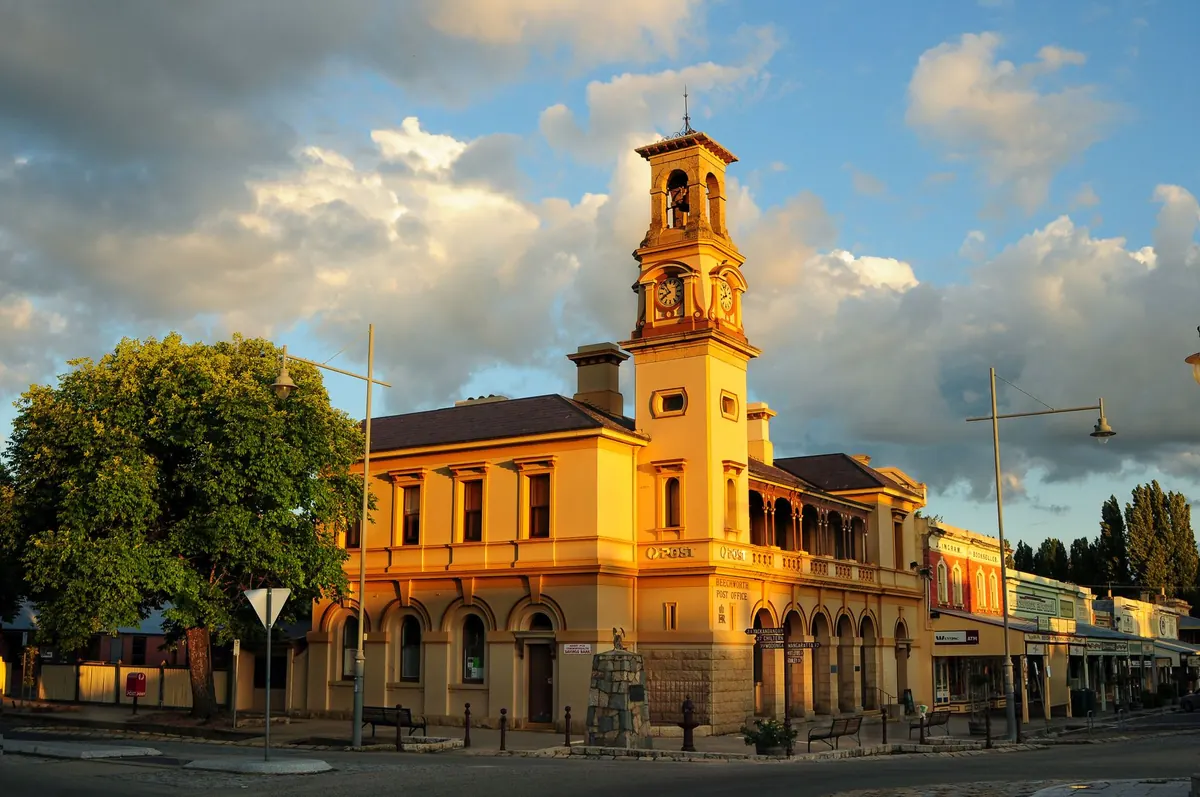
Beyond boxes, keep an eye out for former post offices and receiving houses, mail coach inns, milestones and tollhouses on the old turnpike roads, sorting offices, station platforms that once handled mail trains, and the ordinary street corners named after a post that stood there. These are the stops that make a route feel varied.
A list of interesting places does not make a tour. Walking it does. Work out the distance on a map first, then walk it yourself with a watch. Somewhere between one and two and a half kilometres is comfortable for most groups, and that usually yields ten to fourteen stops in roughly ninety minutes, including pauses.
Note the practical furniture of the route as you go: where the pavement narrows, where there is nowhere to stand out of traffic, which crossing has a long wait, where the only bench is, where the toilets are, and how steep the hill is at the end. Build a shorter step-free alternative, because someone will need it and you will want to have thought about it before they ask.
Choose a theme broad enough to hold the route together but narrow enough to mean something. "How the post came to this street" is a theme. "Every postbox in the parish" is a list.
Give the walk a shape: an opening that sets up a question, a middle that answers it in stages, and an ending that lands somewhere satisfying, ideally at a place where people can sit down and keep talking. Give each stop one clear point and, where possible, one human detail — the postmistress who ran the office for forty years, the letter that arrived three weeks late, the box installed only after a long campaign by residents.
Every stop should answer one question. If you cannot say what the question is, the stop is scenery, not a story.
Keep dates to a minimum. Three facts delivered well beat twenty delivered flatly, and nobody remembers a list of years.
Check who owns the ground you plan to stand on. Shopping centres, station forecourts, churchyards and private estates may need permission or may simply be unsuitable for a group of fifteen. Keep groups small enough to hear you without shouting, generally somewhere between ten and twenty people.
If you are organising this formally, or charging for it, look into public liability insurance and a simple risk assessment, and check whether your local authority requires anything from walk leaders. That is worth a phone call or a look at your council's guidance rather than a guess, and if money or liability is involved, take proper advice.
For publicity, the local library, the history society, the civic society and any walking festival are natural allies. Always name a wet-weather alternative or a straightforward cancellation plan.
Do a full dry run at the same time of day you intend to run the tour. A market day, a bin day or the school run can turn a pleasant route into a shouting match. Time every stop out loud, as if people were listening, and cut the two weakest ones. You will almost always finish over time on the first attempt.
You do not need a town's entire postal history. Pick one street, find five stops, and walk it in forty minutes for two or three tolerant friends. Note where they asked questions, where they drifted, and where they laughed. That is your real script. Add a second street when the first one runs smoothly, and by the third you will have something the local history society will happily put in its programme.
Photo: Kenny Foo / Pexels