A birthday card to a cousin in Ontario. A signed contract to an office in Berlin. A letter to a pen pal in Kyoto who has waited three weeks for it. Underneath all of them sits the same modest rectangle of paper, doing one job: telling a sorting machine, and then a human being, exactly where the letter is going — and where to send it back if it cannot get there. Rearrange the lines, leave off a postcode, and your careful handwriting ends up in a returns bin a fortnight later. The good news is that international addressing runs on a small, learnable set of conventions. Once you have them, the envelope takes two minutes.
Strip away the local quirks and almost every international address is built from four pieces of information, written from the most specific to the most general:
Give each block its own line. Keep the whole thing in Latin script: if the destination uses Cyrillic, Greek, Arabic or Japanese characters, write the address in Roman letters as well, since that is what the machinery in your own country reads first. Moscow 101000, Russia will travel; a line of Cyrillic may not. Use black or blue ink, print rather than join letters, and skip commas and full stops — they add nothing and occasionally confuse optical readers.
This is the part most people get wrong. The order of the lines should match what a local postman expects to see, not what looks tidy in your own language. These are the broad patterns.
Across Europe and North America the number comes first: 12 Rue de Rivoli, 44 Kirchstraße, 9 Elm Grove. Japan again inverts this, since addresses are organised by district and block rather than by named street — which is one reason a copied format from the recipient's own letters beats guesswork every time. If you have ever received mail from the person you are writing to, copy the layout exactly, spacing and all.
Put the country on the last line, in capitals, with nothing else beside it. Spelling it out in English is the safest habit: GERMANY rather than Deutschland, JAPAN rather than Nippon. Postal workers in your country sort by that final line, so make it unmissable. Avoid abbreviations such as U.K. or UAE where a full name fits, and never translate a country into a nickname or a historical name — PERSIA and HOLLAND will slow things down or stop them.
Always include one. Undeliverable international mail is expensive to handle, and a return address is what brings your letter home instead of into a dead-letter pile. Practices differ by country, though, so it is worth knowing both conventions:
If you want certainty, use the front upper left. Write your return address in Latin script too, small and tidy, and include your own country name — your postal service needs it if the letter comes back. Do not write anything on the back that could be mistaken for a delivery address.
Read the envelope once, out loud, from the top down. Then check that the destination country is on the last line in capitals; that the postcode is correct and matches the town; that the return address includes your country; that the stamp is top right with enough postage for the weight; that the bottom edge is blank; and that every line is in Latin script and legible to someone who has never seen your handwriting before.
If all six pass, seal it. The letter has done its part. Address it as though a stranger in a sorting hall has five seconds to read it, and it will arrive where it is meant to go — which is, after all, the only thing an envelope was ever asked to do.
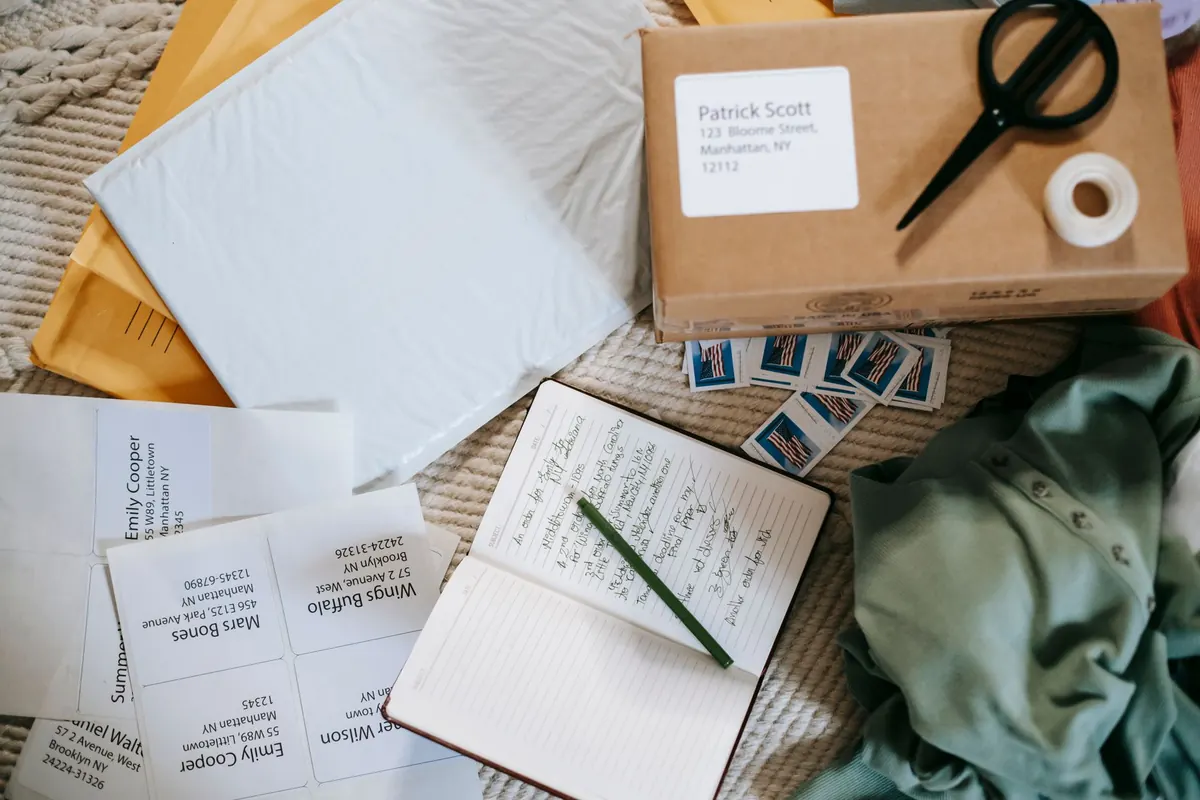
Photo: Liza Summer / Pexels